Why I Almost Missed the Best Swiss Beers
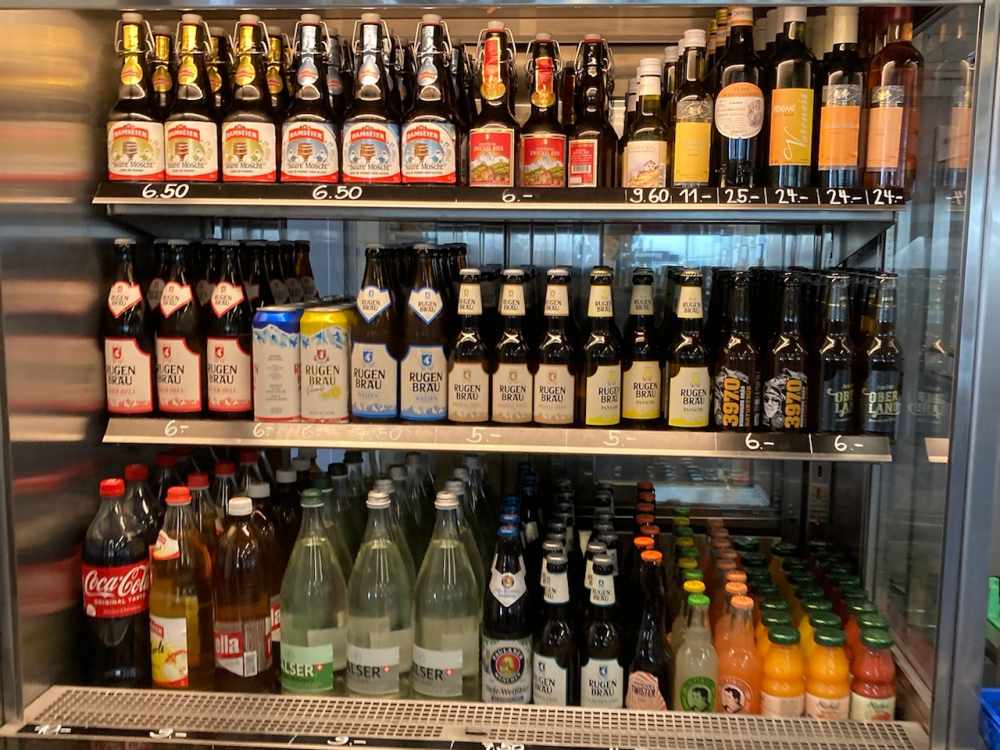
Before my trip to Switzerland, I searched for Swiss beer guides and found almost nothing. Compared to the mountains of content on German or Belgian beer, information on Swiss beer is surprisingly thin on the ground. So I ended up doing what a lot of travelers do: wandering the refrigerated aisle of a local supermarket (usually Coop), picking bottles based on packaging alone, and hoping for the best.
It mostly worked. But when I got home and finally did my research properly, I realized I’d walked right past a few classics I should have tried. I’d also bought a French beer (1664 Blanc) thinking it was Swiss — which it very much is not.
This guide is what I wish I’d had before I left. It’s not a definitive ranking of every Swiss beer that exists. It’s a personal account of what I actually drank — in Grindelwald, on the mountainside, at Zermatt restaurants, and from Coop shelves — plus a few brands worth knowing about before you go.
What This Guide Covers
- 4 nationwide Swiss beers you’ll see at every supermarket and restaurant
- 4 regional beers I discovered in Grindelwald and Zermatt
- One practical tip I wish someone had told me before I left home
- The best Swiss beer souvenir you can bring back
- The French beer that looks Swiss (and is delicious anyway)
Swiss Beer Culture: What to Expect
Switzerland isn’t the first country that comes to mind when you think of beer culture, but the brewing tradition runs deeper than most visitors expect. There are over 1,000 independent breweries in Switzerland — a surprisingly high number for such a small country — most operating at a regional or local scale. Around 70–80% of what’s consumed is lager or pilsner, so if you enjoy clean, crisp, easy-drinking beers, you’ll feel right at home. What Switzerland lacks in hoppy complexity, it more than makes up for in drinkability and alpine setting.
The country’s cultural geography shapes what you’ll find on tap. The German-speaking regions (Zurich, Bern, Grindelwald, most of central Switzerland) have the strongest beer culture — lagers are the everyday drink. French-speaking Switzerland (Geneva, Lausanne) leans toward wine. Italian-speaking Ticino goes for grappa and wine. But you’ll find Swiss beer available everywhere regardless.
Prices are what you’d expect from Switzerland: roughly 2–3 CHF for a 500ml can in supermarkets (Coop, Denner, Spar), and more at restaurants. Tap beer at a mountain restaurant is one of life’s genuinely good experiences.
Nationwide Swiss Beers (Available Everywhere)
Feldschlösschen

If you see one Swiss beer logo more than any other, it’ll be Feldschlösschen’s red castle. This is the country’s biggest beer brand, and it’s everywhere — from airport shops to mountain huts at 2,000 meters. I must have walked past it fifty times before I finally ordered one.
It’s a textbook Swiss pilsner: clean, light on bitterness, with a subtle malty backbone and a dry, refreshing finish. Nothing surprising, nothing complicated — just a very well-made everyday lager. If you’re new to Swiss beer and don’t know what to order, start here. At around 2 CHF a can in supermarkets, it’s also one of the best-value options in one of Europe’s most expensive countries.
If you spot it on draught, order it that way — the tap version is noticeably smoother than the can.
| Spec | Details |
|---|---|
| Style | Pilsner / Lager |
| ABV | 4.8% |
| Brewery | Feldschlösschen Getränke AG |
| Founded | 1876 |
| Availability | ★★★ (everywhere) |
Quöllfrisch (Appenzeller Bier)

Quöllfrisch is brewed by Brauerei Locher in Appenzell — a small, tradition-obsessed canton in eastern Switzerland. The name means “fresh from the spring,” and it tastes like it: remarkably smooth and gentle, with a natural sweetness and very little bitterness. It’s the kind of beer that people who don’t usually like beer often find themselves enjoying.
Beyond the taste, the packaging is genuinely appealing — mountain motifs, Appenzell-inspired artwork, and compact 350ml cans that fit easily in a daypack. It’s consistently one of the most popular Swiss beer souvenirs, and after trying it, I completely understand why. Find it at Coop and other supermarkets across the country.
| Spec | Details |
|---|---|
| Style | Helles / Natural Lager |
| ABV | 5.2% |
| Brewery | Brauerei Locher AG (Appenzell) |
| Founded | 1886 |
| Availability | ★★★ (everywhere) |
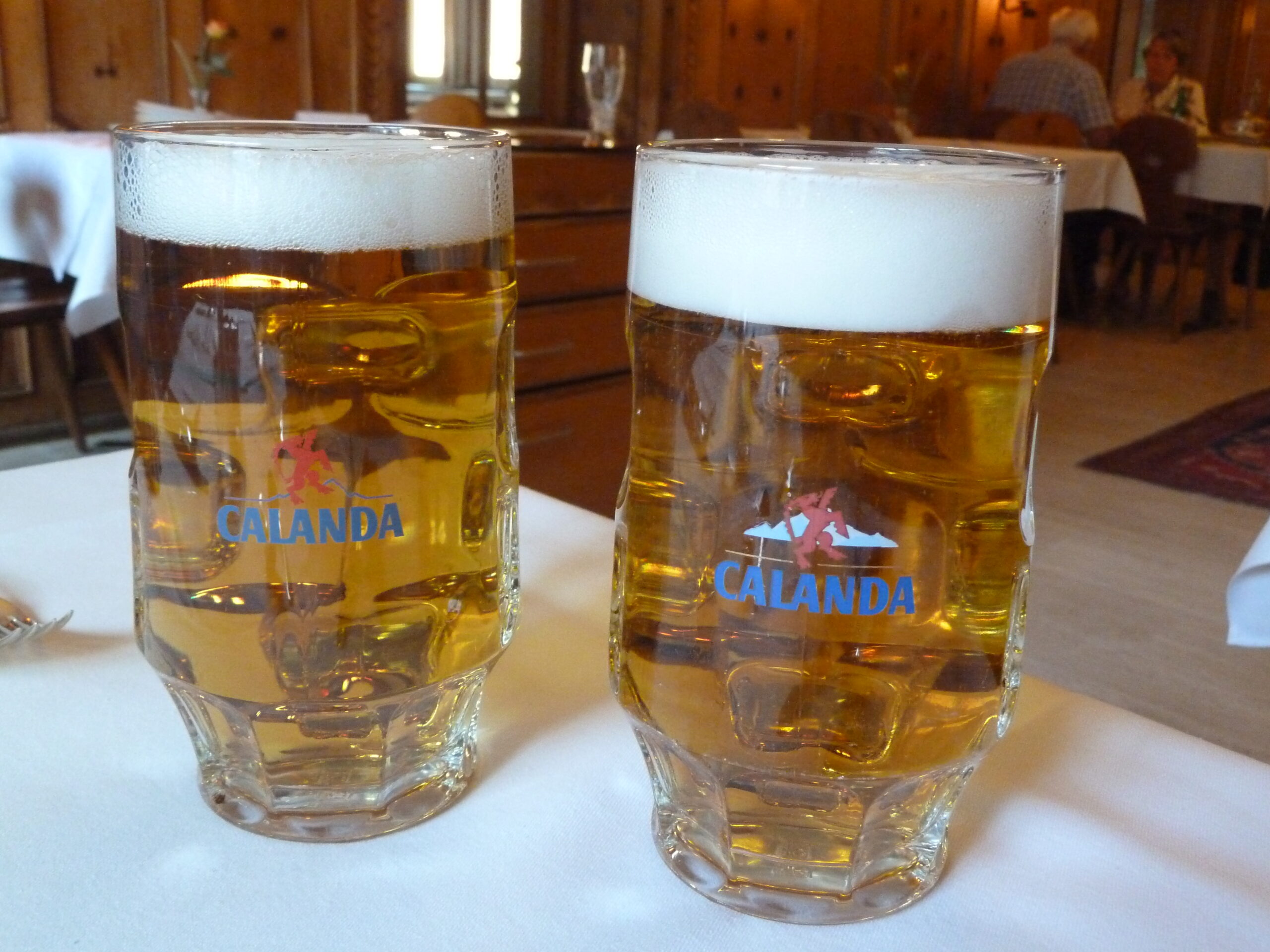
Calanda
Calanda comes from Graubünden — Switzerland’s largest, most mountainous canton in the east. It’s brewed using Alpine spring water, and you can sense it in the glass: clean, light-bodied, with a crisp finish and no rough edges. It’s not trying to be complicated, and that’s part of its appeal.
Calanda is the default lager in eastern Switzerland — if you’re spending time in Chur, Davos, or the Engadin Valley, you’ll likely see it on tap at local restaurants. It’s now owned by Heineken, but the recipe and character remain decidedly local.
| Spec | Details |
|---|---|
| Style | Lager / Pilsner |
| ABV | 4.8% |
| Brewery | Calanda Haldengut AG (Heineken) |
| Founded | 1834 |
| Availability | ★★★ (eastern Switzerland especially) |
Ittinger Klosterbräu
If you want something different from the standard Swiss lager, Ittinger Klosterbräu is the one to reach for. This amber ale is inspired by the traditions of the Kartause Ittingen monastery in the canton of Thurgau. It is now brewed by Heineken Switzerland AG at the Eichhof brewery in Lucerne, using hops still grown on the monastery grounds. The result is a reddish-amber beer with soft caramel sweetness, toasted malt, and a gentle warmth that makes it feel substantial without being heavy.
It’s more interesting than most Swiss beers and pairs well with hearty alpine food. Worth seeking out at a specialty beer shop or quality restaurant.
| Spec | Details |
|---|---|
| Style | Amber Ale |
| ABV | 5.0% |
| Brewery | Heineken Switzerland AG / Eichhof (recipe from Kartause Ittingen) |
| Founded | 1886 |
| Availability | ★★☆ (specialty shops and restaurants) |
Local Finds: What I Discovered in Grindelwald and Zermatt
This is the section I wish someone had written for me before my trip. These aren’t the beers you’ll find in every supermarket — but they’re the ones worth going slightly out of your way for.
Rugen Bräu (Grindelwald area)

Rugen Bräu is brewed in Interlaken and is essentially the house beer of the Grindelwald and Jungfrau region. I ordered the Weizen (wheat beer) at a mountain restaurant, sat down with an unobstructed view of the Alps in every direction, and had one of the most memorable beers of my life.
To be fair to the beer itself: it’s genuinely excellent. Fruity and mellow, with the classic banana-and-clove aroma of a well-made Bavarian-style Weizen, and a soft, creamy mouthfeel that makes it dangerously easy to drink. But the setting elevated it to something else entirely. If you’re in the Grindelwald area and spot this on a menu, order it. The combination of cold Weizen and alpine scenery is, I’ll say plainly, one of the best things about traveling in Switzerland.
| Spec | Details |
|---|---|
| Style | Weizen (Wheat Beer) |
| ABV | 5.2% |
| Brewery | Rugenbräu AG (Interlaken) |
| Where to find | Restaurants and shops in the Grindelwald / Interlaken area |
| Availability | ★★☆ (Jungfrau region) |
Jungfrau Camper Bier (Grindelwald)

I found this at a local shop in Grindelwald and picked it up mostly because the label was appealing and “Jungfrau” seemed like an appropriately Swiss thing to be drinking in the Jungfrau region. It’s brewed near Brienz lake, not far from Grindelwald — genuinely local.
The taste is a clean, crisp pilsner-style lager: easy to drink, refreshing, with mild bitterness. I had it cold back at the hotel with a ham sandwich. Simple and perfect. The label design is attractive enough to double as a souvenir if you can find it in the right packaging.
| Spec | Details |
|---|---|
| Style | Pilsner / Craft Lager |
| Where to find | Local shops and beverage markets in Grindelwald and surrounding area |
| Availability | ★☆☆ (Grindelwald / Jungfrau region) |
3970 NATURTRÜB (Grindelwald)

I had no idea what this beer was when I picked it up. I just liked the label — a mountain man wearing sunglasses, which is exactly the kind of thing that works on me when I’m browsing a foreign supermarket. It turned out to be one of the best beers of the whole trip.
The name “3970” refers to the altitude of the Eiger (3,967m), the iconic mountain that towers directly over Grindelwald. NATURTRÜB means naturally unfiltered — you can taste it immediately. There’s a soft, wheaty roundness to it despite being billed as a lager, with a gentle sweetness and a full mouthfeel that’s richer than your average Swiss pilsner. Brewed with Grindelwald mountain spring water. If you see it, buy it. This is exactly the kind of local discovery that makes traveling worthwhile.
| Spec | Details |
|---|---|
| Style | Naturtrüb (unfiltered lager) |
| Where to find | Selected alpine shops and beverage stores in Grindelwald |
| Availability | ★☆☆ (Grindelwald area, rare elsewhere) |
Zermatt Bier (Zermatt)

I ordered this at a restaurant in Zermatt, and the presentation is part of the experience — the branded glass has the Matterhorn etched on it. It’s unashamedly tourist-facing in its branding, but the beer inside is straightforward and honest: a clean, easy-drinking lager that worked perfectly alongside a meal after a long day of walking.
One specific note about Zermatt: the supermarket I visited had almost exclusively non-alcoholic beer in its refrigerated section, which caught me off guard. I’m not sure if that’s standard across the town or just that particular shop — but if you’re looking for regular beer in Zermatt’s supermarkets, be prepared for a bit of a search. Restaurants are the more reliable option.
| Spec | Details |
|---|---|
| Style | Lager |
| Where to find | Restaurants in Zermatt |
| Availability | ★☆☆ (Zermatt only) |
One More Thing: The Beer That Isn’t Swiss

You’ll see 1664 Blanc (by Kronenbourg) everywhere in Switzerland — supermarkets, restaurant menus, café terraces. The stylish label makes it very easy to assume it’s Swiss. It isn’t. It’s French, brewed in Alsace.
I nearly included it in my Swiss beer list before I noticed the country of origin. Worth knowing — and worth trying anyway, because it’s genuinely one of the best wheat beers you can find. Fruity, slightly hazy, with a gentle spice from coriander and orange peel. Just know you’re drinking a French beer, not a Swiss one.
Best Swiss Beer Souvenir
Quöllfrisch (Appenzeller Bier) is the obvious pick for something to bring home. It comes in 350ml cans that pack neatly, the design is distinctive and clearly Swiss, and the flavor is interesting enough to be worth explaining to people who haven’t tried it. Coop and other major supermarkets stock it reliably across the country. A few cans travel without any fuss.
Frequently Asked Questions
What is the most popular beer in Switzerland?
Feldschlösschen is Switzerland’s biggest beer brand by volume and the one you’ll encounter most as a traveler — it’s on tap at virtually every mountain hut and stocked in every supermarket. Among locals who want something with more character, Quöllfrisch (Appenzeller Bier) has a strong following. Both are good starting points.
Do Swiss people drink a lot of beer?
More than you might expect. Switzerland’s per-capita beer consumption is above the world average, and the German-speaking regions have a genuine beer culture. That said, wine is arguably more culturally significant in French-speaking Switzerland. In practice, beer is available and enjoyed everywhere across the country.
Where can I buy Swiss beer in Switzerland?
Coop is one of the main supermarket chains and has an excellent beer section at reasonable prices. (Note that MIGROS, another major chain, famously doesn’t sell alcohol in its core supermarkets — pick up beer at Coop, Denner, or Spar instead.) Most restaurants and mountain huts serve at least one local lager on tap. For regional specialties — like Jungfrau Camper Bier or 3970 NATURTRÜB — look in local independent grocery stores or kiosk shops near wherever you’re staying. Some of the most interesting beers are only available close to where they’re brewed.
Is Swiss beer expensive?
By European standards, yes — but less dramatically than you might fear. Supermarket cans typically cost 2–3 CHF. A beer at a restaurant will run 5–9 CHF depending on location. At the top of a cable car with a view of the Matterhorn, that suddenly feels entirely reasonable.